Black Soldier Fly Farms in Kenya: A SWAP Project Reflection by Jamie JudahBram
By Jamie JudahBram, Stanford Student, Human Biology Program
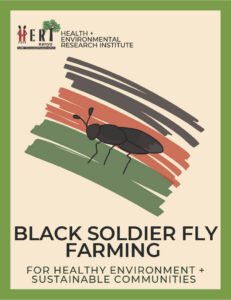
Kenya generates an estimated 22,000 tons of waste per day, 60-70% of which is organic. Unmanaged organic waste drives the spread of diarrheal and mosquito-borne diseases, habitat degradation, and general pollution. Desiree LaBeaud and Francis Mutuku’s HERI-Kenya is working with Kenyan communities to address this through the black soldier fly (BSF), a small, nonpest fly whose larvae consume organic waste and produce frass, a sustainable crop fertilizer, while the larvae itself serves as nutritious animal feed. Women are already the primary managers of waste in their homes, and HERI-Kenya is dedicated to extending that role into the community. My project was to write and design an instructional booklet guiding women farmers through everything they need to start and manage their own BSF farm, from permits and setup to caring for larvae and harvesting products. To honor that mission, I made sure most of the images featured women exclusively.
I learned how much it matters to know your audience. My early drafts were more word-heavy and complex than my final version. After discussing with the Kenyan team, I shifted my focus from creating a comprehensive guide to an approachable starting point, one that meets a farmer where she is. This meant simplifying the English and prioritizing visuals so farmers at any comfort level could follow along. My favorite part is a call-to-action poem LaBeaud suggested I write after asking me what my favorite medium of communication is. I used rhyme and repetition to make it memorable and reading accessible. It means a lot to me that I got to bring that piece of myself into this work.
After HERI-Kenya’s in-person BSF training events, the booklet will be distributed and feedback collected so I can keep adapting it to better serve the community it was made for. As someone who hopes to become a pediatric cardiologist and public health researcher, this experience deepened my understanding of community-informed work. SWAP showed me that science communication is not just about translating research but about genuinely listening to the people you serve. I am so honored to have created something directly shaped by and made for a community I resonate with deeply as an African American.